Analyzing the Filibuster
What is it? Is it historical or modern? Is it what the Founding Fathers intended? Is it useful?

A lot of hubbub has been made over the past few years about the filibuster, and the so-called “nuclear option,” but a lot of people either don’t know what the filibuster is, or have incomplete, sometimes pop-culture influenced ideas of what the filibuster actually is.
Today I’m going to ask a few key questions:
What was the original incarnation of the filibuster, in the US Congress?
What is the current incarnation or status of the filibuster, in the US Congress?
Does the current incarnation or status of the filibuster match or honor the historical, or originalist, intent or purpose of the filibuster of old?
Is the current incarnation or status of the filibuster actually useful or conducive to good governance?
1. What was the filibuster, originally?
Originally, the filibuster was the result of a change in senate rules in 1806, and was created somewhat by accident, according to Sarah Binder at the Brookings Institution. The filibuster is not in the Constitution nor was it originally envisioned by the founding fathers, but rather it was created when the Senate abolished their own rule that allowed for a simple majority (meaning a vote that has more yay’s than nay’s, not necessarily any specific amount) to cut off debate on an issue if they wanted. The House, the lower chamber of the US Congress, essentially has no filibuster because they have a maximum duration for debate, except for party leaders.
In 1806 the Senate revoked their rule to allow a simple majority to cut off debate and this resulted in the filibuster. But they didn’t realize it, at the time. The filibuster wasn’t actually intentionally created, and wasn’t envisioned at all, and was never used until 1837, more than 30 years after they got rid of the idea of a simple majority to end a debate. The filibuster was in fact not anything intentionally created, but was in fact an accident: if there’s no rule that allows a simple majority to end debate, then theoretically a person can continue a debate by talking indefinitely, never ceding the floor.
Except for cloture.
Senate rule XXII allows the senate to essentially end debate on an issue with a 3/5ths vote (60 senators out of 100), essentially resulting, for the past several decades, in the need for 60 senators to vote to pass any legislation, or else be filibustered. But why is this so pressing in the previous several decades?
2. What is the modern incarnation or status of the filibuster?
In the 1970s, the idea of a “silent filibuster” was created as the consequence of another rule change introducing the “two track” system, meaning that merely stating the intent to filibuster essentially has the same force as actually filibustering. Hollywood portrayals of senators speaking ad nauseum for hours and hours, or days, on end, are not reality anymore - they haven’t been for 50 years. The “two track” system means that legislation that is obstructed, such as by filibuster, is essentially placed on a separate “track” of senate business, and put aside while they can move on to other business that isn’t (yet) obstructed. Before the 1970s when this change was introduced, a filibuster didn’t just hold up one motion - it held up all Senate business because there was no concept of simply moving onto other matters while one motion was being obstructed.
Although not an original source, this explanatory article with its own sources helps explain this. Essentially, in the 1970s, the idea that you had to actively talk to filibuster and obstruct anything in the Senate, was removed. Now you could simply say you’re going to filibuster something and it’s got the same impact - now it needs a 3/5th majority, or 60 senators, not merely a majority, to pass.
3. Is this what the Founding Fathers intended? Is the filibuster, especially its modern incarnation, originalist at all?
To answer this we have to consider what the original intent and purpose of the Senate was. What is the US Senate, and what is different between it and the House of Representatives?
The House of Representatives, the “lower” chamber of the United States Congress, is essentially the “people’s representatives” in the US legislature. Representatives are apportioned to states based on population (though now with a set maximum of 435 total) and states decide how to organize their districts so politicians can figure out which district they’re running in, and therefore who they represent. Anyone living in those districts, is their constituent, and the politician represents those people in the United States Congress - not the state, not the city as an entity, but those people.
The Senate, by contrast, is actually not a representative of the people, but a representative of the States, as legal entities, and this is why each state gets exactly 2 Senators, no more, no less, regardless of population. This is logically deduced but also strongly implied in Article V of the US Constitution, which discusses how the Constitution itself may be amended, and at the very end contains the words, “and that no State, without its Consent, shall be deprived of its equal Suffrage in the Senate.” Not the House, but the Senate. The Senate is where the States are represented - and the States are polities that contain, and should be concerned with the will of, people, but the Senate is fundamentally different in that the States are essentially represented in the Senate, while the House fundamentally represents the people directly.
If you read through the Constitution you will also see that the Senate has special responsibilities that the House does not have, which mirror the fact that the United States is in fact a union of the States, and therefore the States’ representatives have special powers and responsibilities that the House does not necessarily have. For instance, the Senate alone has the power to approve nominees to the Supreme Court of the United States. The House of Representatives has no say. More on this is found in Article II, Section 2, of the Constitution:
He shall have Power, by and with the Advice and Consent of the Senate, to make Treaties, provided two thirds of the Senators present concur; and he shall nominate, and by and with the Advice and Consent of the Senate, shall appoint Ambassadors, other public Ministers and Consuls, Judges of the supreme Court, and all other Officers of the United States, whose Appointments are not herein otherwise provided for, and which shall be established by Law: but the Congress may by Law vest the Appointment of such inferior Officers, as they think proper, in the President alone, in the Courts of Law, or in the Heads of Departments.
The Senate clearly is not a truly “democratic” institution in that it is not a representative of the people, but rather they are representatives of polities - in this case the States in the United States of America. Among other things, this is commonly understood to provide a check against simple majority rule, also called “tyranny of the majority,” which a simple populist representative government can easily fall victim to - if 51% of the people want to behead someone unjustly, and you have a purely representative vote of the people to decide such a matter, then an unjust beheading you shall have. But the Senate is not apportioned by population and does not directly represent the people, rather the state (despite being chosen by election of the people, in their state). It is very easy, and incredibly common, to have a majority of the population of the United States support a variety of ideas or laws, and none of them will be passed into law, because the population is not arranged in the states in such a way to give the Senate a majority vote to make such a bill pass. This is an inherent check against simple majority rule in the nation on the federal level.
And this is why the Senate merely needs a simple majority to pass legislation, as originally envisioned by the first Senate rules. The Senate’s very existence is already a check against the tyranny of the majority, having a majority of the House and the Senate would mean not only that a majority of the people’s representatives, but a majority of the States as well, support making something into law, which is far stronger than mere majority rule of the population.
By requiring 3/5ths for literally every piece of legislation for the last 50 years (and until very, very recent history, even for confirming federal appointments), this has produced a wildly ineffective system whereby even a majority of states and a majority of people cannot pass legislation. This does not seem to be what the founding fathers originally envisioned for the Senate (if it were, they surely wouldn’t have made the Senate function by simple majority when they created it - the first filibuster occurred more than 50 years after the creation of the United States, and the modern rules were passed in the 1970s, hardly the “original intent” in any sense of the word.)
The current rules essentially just mean that what the founding fathers originally intended - a Senate that works with a House to pass legislation by majority vote - no longer functions as originally intended.
4. Does the modern filibuster lend itself to competent and efficient governance?
If you ask a Democrat when Democrats use the filibuster to stop Republican motions, they’ll probably say yes. If you reverse the situation - ask a Republican when the Republican party is using the filibuster to stop Democrat motions in the Senate - they’ll also probably say yes.
That just means it’s a very partisan tool. That’s already a bit worrisome. If each side only ever favors it when it works in their favor, that’s a red flag in and of itself.
Interestingly, if you look at this poll, the confidence in the US Congress has been plummeting nearly constantly since the 1970s.
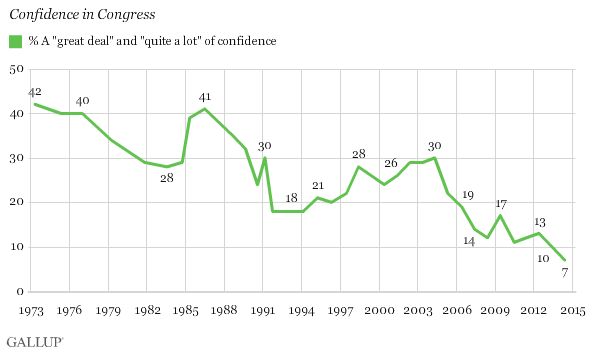
Meanwhile, if you look at this graph, you see the number of cloture votes per year in the US Senate - for the most part, every vote represents the number of times the filibuster was used and then overcome (in the case of a successful cloture vote).

As cloture votes rise, voter confidence in the institution of the US Congress drops.
It’s difficult to really say whether or not a government is competent and efficient, and it’s even more difficult to pin the result of such a question on any specific cause or causes - it is rather telling however that the US Congress has been getting more and more polarized since the 1970s, as the filibuster has been getting used more and more for basically every motion, also coinciding with unbelievable drops in public confidence for the institution itself. These correlations seem to match what many people experience in their day to day lives, at least based on who I personally speak with, which is that they think Congress is incompetent, slow, can’t pass anything to save their lives (or their constituents lives - sometimes literally), and it’s too polarized.
On the face of it, it seems odd that it requires almost as many votes simply to pass any legislation at all (3/5ths), as it does to convict the US President in an impeachment trial (2/3rds). Given that no President has ever successfully been convicted in the Senate, that might give us a hint as to how difficult it is to pass a bill with such numbers of support, if it’s even slightly controversial.
As Congress (both chambers, not merely the Senate) becomes more polarized, it seems like the proverbial pressure is building up - as nothing gets passed that either side actually cares about and wants to pass, partially (or largely) because of this historically anathema filibuster we now have, both sides progressively get not just more desperate but more hateful of the other side for holding up what they see as meaningful progress. Not only is tyranny of the majority avoided (which it still would be with a simple majority Senate, as discussed earlier), but tyranny of competence is avoided as well, leaving room only for frustration and the perfect breeding grounds for extremism.
Addendum: What is the “Nuclear Option?”
Essentially, the Senate can have a simple majority vote to nullify one of its rules, but this is seen as dangerous by Senators because both sides have gotten more partisan (and in each other’s views, more extreme), so giving either side carte blanche to pass anything they want by simple majority is a frightening proposition to the other side. So both sides - for now - seem to want to keep the filibuster in fear of the other side having a majority in both chambers of Congress and passing things the other side doesn’t like. They quite literally would rather have a do-nothing Senate rather than a Senate they don’t control. This, too, seems anathema to the true intent of a competent and healthy legislature.